An R package and Shiny proof of concept for drafting SAS macro test cases from functional requirements documents (FRDs) and SAS source. Statistical programmers can prepare a prompt offline or request a validation matrix, sample data, and SAS programs through OpenRouter.
Generated content requires independent review. The application does not execute SAS, establish test coverage, or enforce an approval workflow.

Get started
Clone this repository and open its root in RStudio. The lockfile records R 4.6.0. Restore the runtime and documentation dependencies, then load the package:
renv::restore()
pkgload::load_all(".")
Run the supplied synthetic example without an API key or network call:
frd <- read_frd("examples/simple_frd.txt")
macro <- import_sas_macro("examples/simple_visit_flag.sas")
result <- generate_sas_tests(frd, macro)
cat(result$prompt)
generate_sas_tests() prepares a prompt; its default test-case and SAS-code fields are empty. source("example.R") runs this workflow with small assertions.
Use the Shiny app
For live generation, add your key to the project .Renviron, then restart R:
OPENROUTER_API_KEY=your-key-here
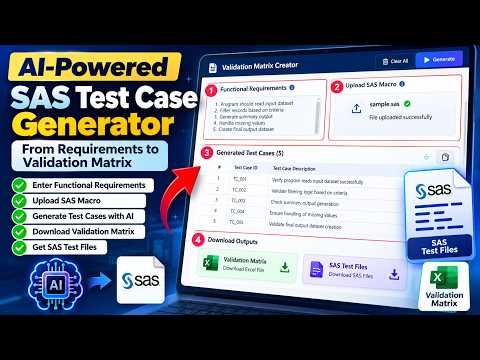
shiny::runApp(".")Paste the FRD, upload one .sas file, check the generation settings, and select Generate test cases. The app displays six matrix columns and downloads Validation_Results.zip containing:
-
Validation_Test_Matrix.xlsx, withValidation_MatrixandSample_Datasheets; -
sas_code.sas; -
sas_test_code.sas.
The app’s model setting and package default are currently gpt-4o-mini, with temperature 0 and a maximum of 4096 output tokens. Confirm that your selected model identifier is accepted by OpenRouter. Live requests may incur provider charges. The app can open without a key; generation requires one.
Data and implementation boundaries
Live generation sends the complete FRD text and SAS source to OpenRouter and its selected model provider. Use public or synthetic examples and only other content approved for those services. The app does not classify, redact, or de-identify inputs. Keep credentials and confidential content out of source control.
The package reads .txt, .md, .markdown, and .sas FRDs. The UI accepts pasted FRD text. PDF/DOCX parsing and SAS execution are outside the current scope. Macro metadata uses regular expressions rather than a complete SAS parser. Successful JSON parsing and matrix display do not establish SAS correctness or requirement coverage. Exports do not retain the original inputs, prompt, model settings, or raw response as a reproducibility record.
Documentation and development
The website navigation provides Get started, Reference, Articles, and Changelog. The corresponding sources in this checkout are:
- Getting started (
vignettes/sastestgenerator.Rmd): package and app workflows. - Architecture (
vignettes/articles/architecture.Rmd): code map and current limits; the canonical source is ARCHITECTURE.md. - Generation contract (
vignettes/articles/generation-contract.Rmd): requested JSON, displayed matrix, downloads, and failure behavior. -
Contributor guidance, change history (
NEWS.md), and verification record (docs/verification.md).
Build the function help and local website from RStudio:
devtools::document()
pkgdown::check_pkgdown()
pkgdown::build_site(preview = FALSE)
Open pkgdown-site/index.html. Generated site files are excluded from Git and package builds; these local commands do not publish the site.
GitHub Actions builds the website on pushes to master and publishes the rendered HTML to gh-pages. Pull requests build without deploying. You can also run the pkgdown workflow manually from the Actions tab on master. GitHub Pages serves the root of gh-pages at the documentation site. The workflow uses the repository’s GITHUB_TOKEN; no OpenRouter key is needed. CI resolves documentation dependencies through r-lib/actions, following the SubmissionSync setup; local development continues to use renv.lock.
There is no committed automated test suite yet; run the offline example and devtools::check() when checking the package. Live generation, browser behavior, and SAS execution require separate verification.