BDS data profiling and plotting eligibility
Source:vignettes/articles/02-bds-profiling-eligibility.Rmd
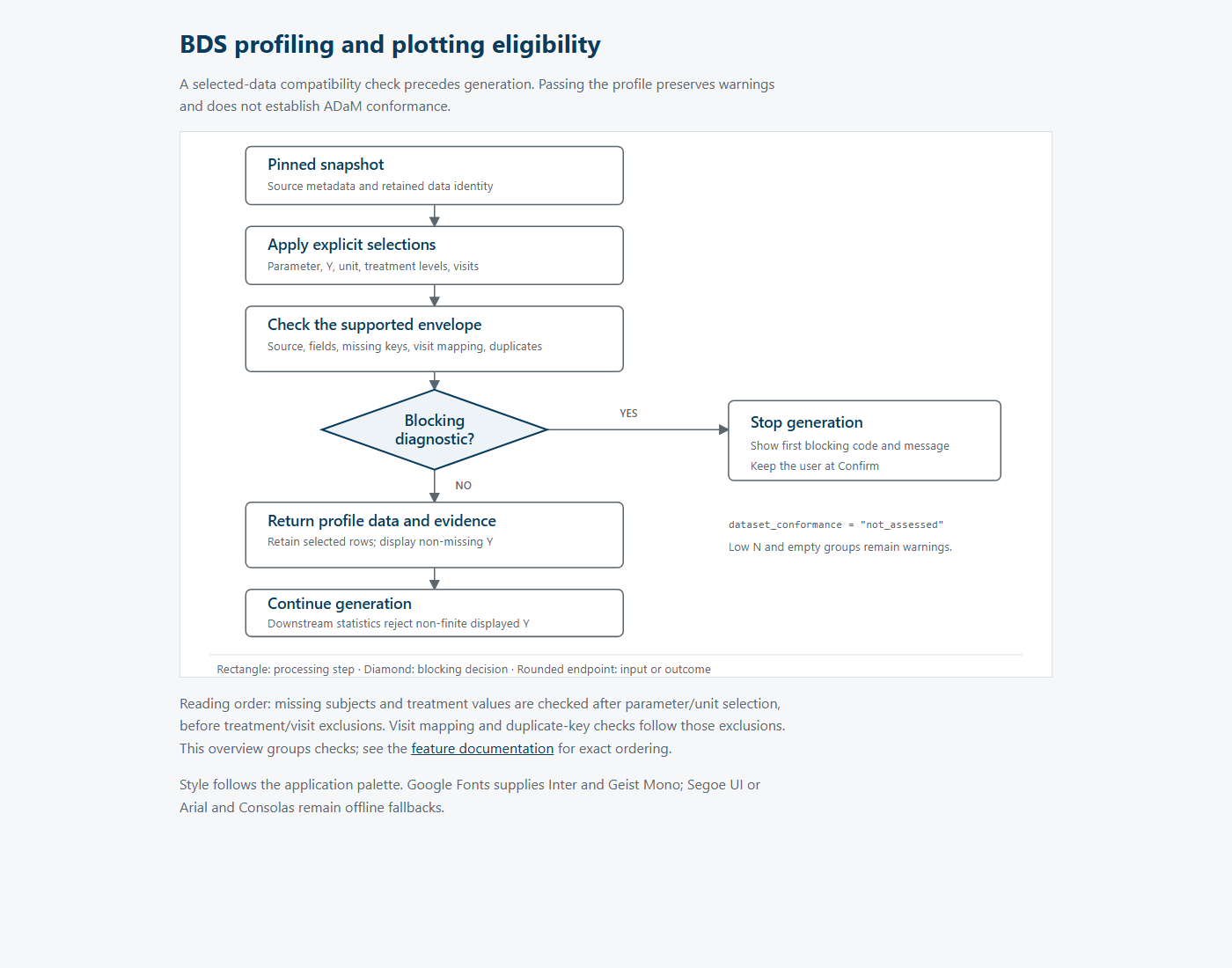
02-bds-profiling-eligibility.RmdThe application checks whether selected records support its
longitudinal numeric BDS boxplot before generating a result. Passing
this check establishes compatibility with one plotting pattern. The
result explicitly records
dataset_conformance = "not_assessed"; it does not establish
full ADaM conformance, data provenance, or statistical suitability for
an intended clinical analysis.
Two checks with different scope
The upload adapter, .uploaded_study_data_provider() in
mod_plot_generation.R,
checks the parsed file before creating a provider. It requires populated
records, unique non-empty column names, and USUBJID,
PARAMCD, PARAM, AVISIT,
AVISITN, AVAL, and AVALU. Both
AVAL and AVISITN must be numeric. At least one
treatment column must match ^TRT(A|P|[0-9]+[AP])$, covering
names such as TRTA, TRTP, TRT01A,
and TRT01P. Selectable parameters, names, units, visits
with finite order values, and treatment values must exist somewhere in
the file. This is a whole-file admission check, rather than a complete
validation of every row. Wide-format visit columns receive guidance to
reshape into long format; the adapter does not reshape them.
validate_bds_profile() in bds_profile.R
then evaluates a pinned snapshot and six selections:
paramcd, y_variable, unit,
treatment_variable, treatment_levels, and
visits. The parameter and treatment variable must each be
one non-empty string. The selected Y variable must be AVAL,
CHG, or PCHG and numeric. Its required columns
are USUBJID, PARAMCD, AVISIT,
AVISITN, the selected Y column, and the selected treatment
column. AVALU is used when present. Consequently, the
upload requirements are stricter than this lower-level profile API.
How selections affect checking
The profile first requires BDS source metadata. A classified snapshot
must be public, synthetic, or deidentified. A snapshot without
classification is accepted only when its source is
direct_upload. Direct-upload metadata therefore permits
profiling without proving that the data meet the permitted-data
policy.
The chosen treatment variable must belong to the snapshot’s permitted catalog, and the parameter must exist. The profile selects that parameter and discovers its non-missing units. Multiple units require an explicit choice; an unavailable choice blocks. Selecting a unit removes records with another unit or a missing unit. With no explicit unit and at most one discovered unit, the API does not apply a unit filter. Confirmation has its own completeness requirements in domain_plot_spec.R.
Missing or empty subject identifiers and treatment values block at
this point, before treatment-level and visit
exclusions. Treatment choices default to all available levels when
NULL. Explicit levels must be unique, non-missing, and
available; the resulting order follows the sorted available levels
rather than the order supplied by the caller.
Visit exclusions precede mapping and duplicate checks. Missing visit
labels are deliberately retained during this filtering so they can
trigger a diagnostic. Every retained visit label must map to exactly one
non-missing AVISITN, and each order value to exactly one
label. Visits are ordered by AVISITN, then label. Requested
visits must still exist after parameter, unit, and treatment
selection.
Duplicate
USUBJID–PARAMCD–AVISIT keys
block. If duplicates coexist with additional declared keys beyond
STUDYID, USUBJID, PARAMCD,
AVISIT, and AVISITN, the diagnostic is
unsupported_additional_timepoint_keys; otherwise it is
unsupported_duplicate_visit_key. Legitimate within-visit
timepoints remain outside this cell’s supported envelope. Neither
diagnostic declares the source invalid ADaM.
Retained records, displayed records, and warnings
A successful profile returns sorted selected_data and
display_data. Selected records retain missing Y values;
display records exclude them. Stored CHG and
PCHG values are used directly. The profile does not derive
them or silently apply SAFFL or analysis flags such as
ANL01FL.
For each displayed treatment–visit combination, source_n
counts distinct selected subjects and n counts distinct
subjects with non-missing Y. The default sparse-data threshold is
n < 5. A different threshold requires a list containing
a finite value of at least one, rationale, authority, and version. The
API retains these fields; it does not authenticate sponsor approval.
Low N, combinations with no non-missing Y, and entirely empty included treatment levels produce nonblocking warnings. Empty groups do not receive invented observations or count rows; included facet and visit levels remain explicit. The analytical input hash covers normalized display records, selections, facet levels, visit levels, and the retained low-N policy.
Blocking behavior and enforcement limits
The profile stops at the first blocking diagnostic. Compact durable
diagnostics contain a code, message, and optional count and integrity
reference. Duplicate subject keys are returned separately in
authorized_diagnostics, rather than embedded in durable
diagnostic text.
The confirmation handler displays the blocking code and message and
remains at Confirm. The execution coordinator,
.execute_assurance_revision() in app_server.R,
also checks the profile before compilation. Numeric type alone is
insufficient: the profile can retain infinite Y values, while
calculate_boxplot_statistics() in boxplot_statistics.R
rejects non-finite displayed values downstream. Profiling success
therefore does not guarantee that generation or execution will
succeed.
Coverage and verification status
test-bds-profile.R contains cases for metadata, required fields, explicit units, absent keys, numeric Y, visit conflicts, duplicates, additional timepoint keys, exclusions, unchanged analysis flags, missing-Y counts, empty facets, row-order stability, and retained low-N policy. These tests were inspected, not executed for this documentation change. No R execution, browser behavior, statistical review, or formal validation is claimed here.