Execution verification and revision evidence
Source:vignettes/articles/07-verification-revision-evidence.Rmd
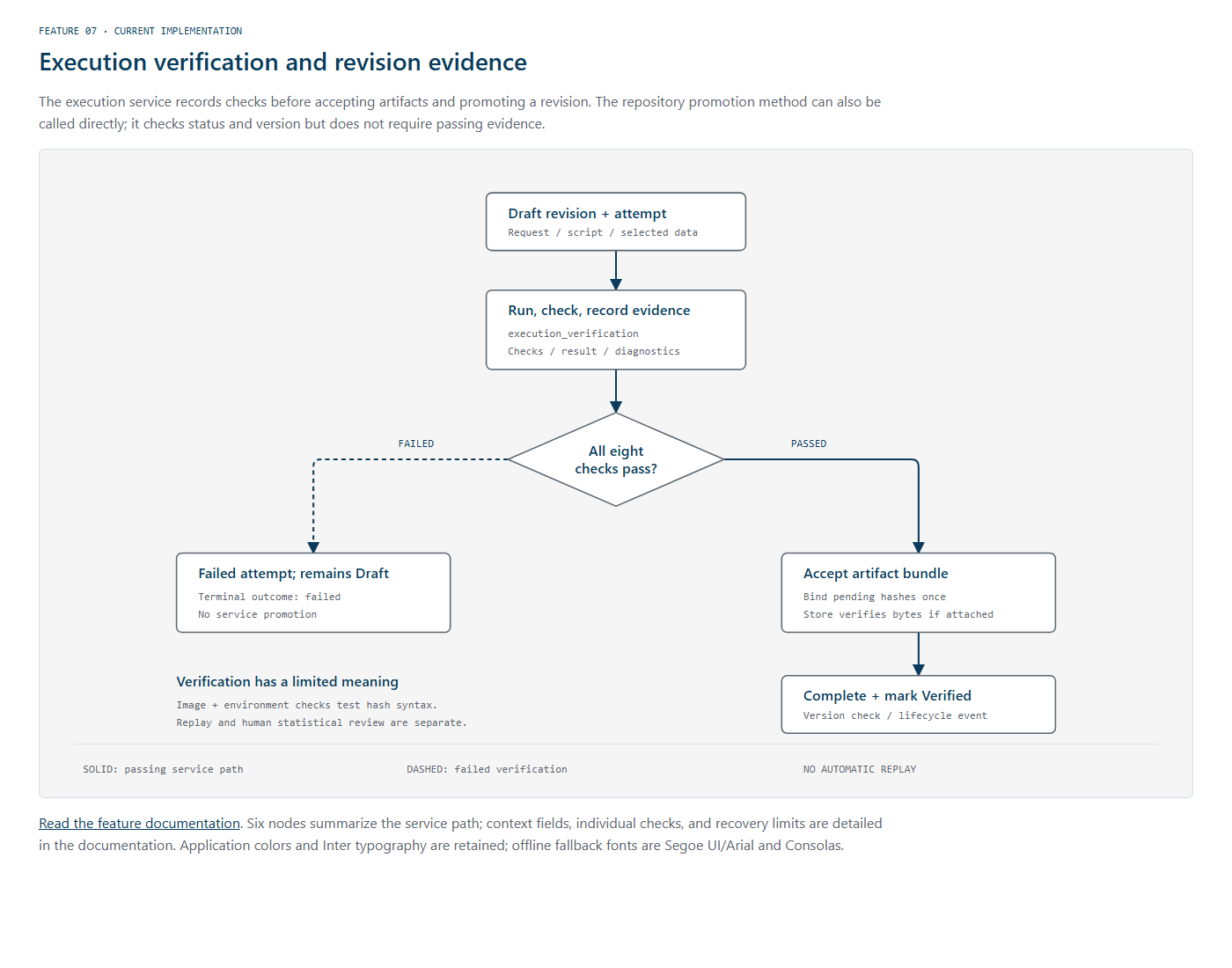
07-verification-revision-evidence.RmdA governed fixed-scale revision becomes Verified when
the execution service records passing checks, accepts its artifact
bundle, completes the attempt, and promotes the revision.
Verified describes automated execution evidence. Human
approval and reproduction of a retained result are separate
operations.
This page describes the implementation inspected on 2026-10-04; test files cited below were read, not executed.
What happens after confirmation
The application coordinator, .materialize_revision() in
app_server.R,
compiles the script and creates an execution request. The request
identifies the confirmed specification, script hash, snapshot
identifier, selected-record hash, and harness version. The
selected-record hash is distinct from the uploaded dataset’s full
content hash.
The coordinator stores script bytes and creates a revision with
pending image and analytical hashes. Fixed scales start at
Draft; free scales start at Experimental/Draft
and skip governed execution. The coordinator later assembles the
displayed preview in the application process. That preview is not the
accepted worker PNG.
new_execution_service() in execution_service.R
accepts only Draft revisions. Its start()
method captures the revision version, records an attempt, and rejects
another active attempt with a different identifier. The attempt
identifier derives from the idempotency key. Its fingerprint includes
the complete request plus hashes of the actual supplied script and
selected records. Reusing an attempt identifier for different inputs is
rejected by the repository.
The checks that determine the outcome
verify_execution_result()
returns execution-verification-v1, a passed or
failed status, named boolean checks, and the names of
failed checks. All eight checks must pass:
| Check | Current comparison |
|---|---|
schema |
Request inherits execution_request; this is a class
check. |
script_hash |
Hash of the supplied script equals the request’s script hash. |
snapshot_hash |
Canonical hash of supplied selected records equals the request’s snapshot hash. |
runner_success |
Runner status is exactly succeeded. |
result_manifest |
Returned result inherits execution_result. |
analytical_hash |
Returned analytical hash equals a canonical hash of the runner’s analytical output. |
image_hash |
Returned image hash matches lowercase 64-character hexadecimal syntax. |
environment_fingerprint |
Returned environment fingerprint matches that same syntax. |
The final two checks do not independently hash the image bytes or environment details. The analytical comparison establishes consistency between two returned values; it does not compare the analysis with an independently reviewed statistical reference.
new_execution_result() in domain_execution_protocol.R
normally copies request fields into the result. The verifier does not
explicitly compare those copied specification, snapshot, script, or
harness fields back to the request. The attempt fingerprint binds
submission inputs, but this does not add result-field comparisons to
verification.
Evidence and accepted artifacts
The execution service first records an
execution_verification evidence entry, for either outcome.
It retains the attempt identifier, verification checks, execution
result, environment information, and runner diagnostics. The SQLite
repository serializes details canonically, stores their content hash,
and registers the evidence command’s idempotency key.
On failure, the service records a terminal failed
attempt and returns without promoting the revision. Runner exceptions
are converted to failed runner results with the error message in
diagnostics.
On success, an injected artifact store receives script and image
bytes. accept_artifact_bundle() in evidence_repository_sqlite.R
binds both pending image and analytical hashes once, checks the bundle
against the revision’s code/image/analytical identities, and permits one
accepted bundle per revision. With an artifact store attached, it
verifies the stored script and PNG against the supplied hashes. local_artifact_store()
calculates SHA-256 from bytes and checks content before publication and
retrieval. An artifact store is optional in the service and repository
contracts; these byte checks depend on its injection.
The service then records terminal success and calls
mark_verified() using the version captured when execution
started. That repository method rejects a stale version or a status
other than Draft, updates the status/version, and appends
revision_verified lifecycle evidence. It does not require
passing execution evidence or an accepted bundle itself. Direct
repository promotion can therefore bypass the service’s verification
gate.
Retained context and recovery limits
After governed execution, .record_revision_context()
records revision-context-evidence-v1. It retains the
prompt, confirmed specification, selected records with column classes,
snapshot/source metadata, generated R code, request/result, environment,
profile warnings, verification, and rendered-output hashes.
Classification is included only when present. This context supports retained-result
reproduction.
Completion uses several repository calls rather than one encompassing transaction. An error during artifact acceptance or promotion can leave partial completion records. reconcile_execution_attempts() marks attempts without terminal outcomes as failed; it neither reruns verification nor repairs promotion. The application does not automatically call this recovery function at startup.
Verification tests cover passing evidence and a missing image hash. Execution-service tests cover promotion, failed verification, runner errors, and exclusion of experimental drafts. Revision-evidence tests inspect retained context and a mocked replay. These sources establish intended checks, not a passing test run, browser proof, independent statistical review, or formal validation. For the upstream execution boundary, see script generation and execution.