Correction revisions and traceability to earlier results
Source:vignettes/articles/10-correction-revision-traceability.Rmd
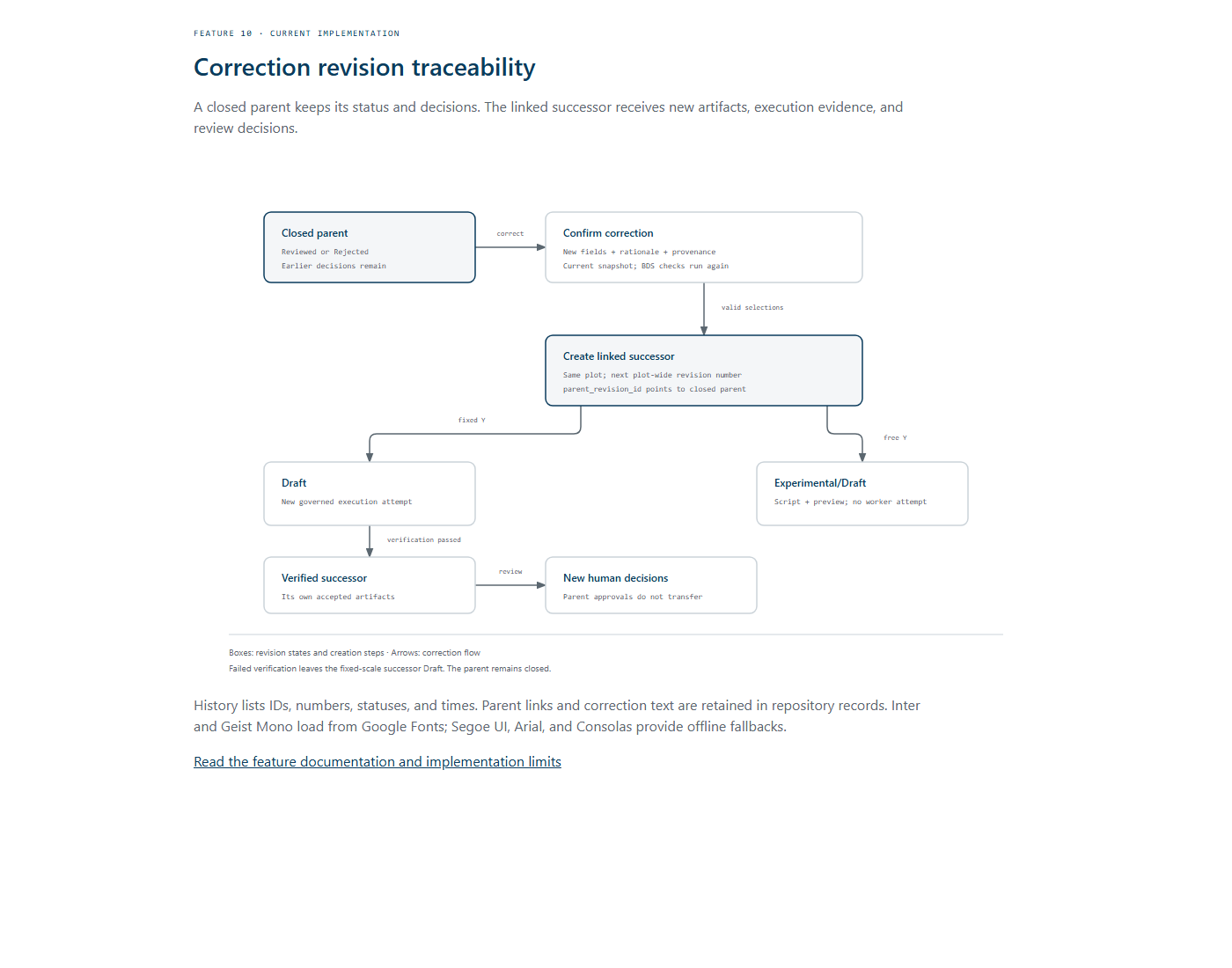
10-correction-revision-traceability.RmdA correction creates a new revision linked to a closed result. The
earlier revision remains Reviewed or Rejected,
with its existing evidence and decisions. The successor receives its own
specification, script, artifacts, execution evidence, and review
decisions. Approval of the parent does not approve the correction.
Starting a correction
The confirmation module offers Create correction
revision when the current state contains a
Reviewed or Rejected revision and
specification choices. The user changes the plotting selections and
supplies both a correction rationale and correction provenance.
Rationale explains why the result needs a successor; provenance records
the source of the requested change. These are required strings. The code
does not validate the accuracy of their content or require a structured
change-request reference.
mod_specification_server() requires explicit
confirmation when the new specification uses free Y scales. It passes
the selected fields and correction text to the coordinator. Errors are
shown as messages in the module. Draft,
Verified, and Experimental/Draft revisions
cannot be correction parents through this path.
The coordinator rereads the parent from the repository before
creating the correction. .execute_correction_revision()
requires a repository, revision, and snapshot; it rejects parents whose
current repository status is not Reviewed or
Rejected. It then confirms the new specification and
validates the selected records against the BDS plotting envelope. A
blocking diagnostic stops the operation before successor creation.
Inputs and defaults
A correction uses state$snapshot and the fields
collected for the current operation. It does not retrieve and replay the
parent’s retained input evidence automatically. In the usual session
this snapshot is the input associated with the current result, but the
parent link alone does not establish input equality.
.current_spec_input_fields() prefers control values,
then the current specification, then available choices. Parameter,
analysis variable, unit, treatment variable, treatment levels, visits,
and scale mode are therefore explicit parts of the successor
specification. Default selection is a convenience for confirmation, not
evidence that the correction must preserve every earlier choice. The
coordinator recomputes the profile and script from the new confirmed
fields.
Stored relationship and identities
new_lifecycle_service()$create_correction() assigns the
next number as the maximum revision number for the plot plus one. The
successor belongs to the parent’s plot_id; its
parent_revision_id identifies the particular earlier
revision being corrected. Numbering is plot-wide, so a successor’s
number need not immediately follow its parent’s number if other
successors already exist.
The SQLite repository independently checks that the parent belongs to
the same plot, has a closed status, and has both correction fields. It
also rejects correction text without a parent. The schema supplies a
parent foreign key and a unique (plot_id, revision_number)
pair. Creation writes the successor, its initial status projection, and
a revision_created lifecycle event within the repository
command transaction. Idempotency keys bind repeated commands to their
payloads.
The revision record contains creator identity, specification and code
hashes, artifact identities when available, initial status, creation
time, parent identity, rationale, and provenance. The application
coordinator currently supplies the literal creator ID
creator. The lower-level lifecycle service accepts a
supplied creator ID; it does not resolve an authenticated correction
author or apply reviewer-role authorization. Review role checks happen
in the separate review service. See human review.
Execution and status of the successor
A fixed-scale correction starts as Draft.
.materialize_correction() compiles and stores a new script,
creates the linked successor with image and analytical hashes pending,
then submits a new governed execution attempt using the selected data.
Passing verification and artifact acceptance can promote this successor
to Verified. A failed verification completes a failed
attempt and leaves the successor Draft; it does not reopen
or reject the parent.
A free-scale correction starts as Experimental/Draft.
The coordinator builds its script and in-process preview without
submitting the governed worker attempt. It cannot inherit the parent’s
verification or review status. See scale paths and verification
evidence.
The application updates its reactive current revision after the correction function returns. Successor creation occurs before execution and preview assembly finish. If a later operation throws an error, repository records may already contain the child while the UI still holds the parent. The entire correction workflow is not one database transaction.
Inspecting history and limits
mod_revision_history_server() lists all revisions for
the plot and rereads each current status. The table shows revision ID,
number, initial status, current status, and creation time. It does not
show the parent link, rationale, provenance, or a field-level difference
between specifications. Inspect repository records and revision evidence
to establish those relationships; adjacent rows alone do not prove
direct ancestry.
Tests inspected cover rejection followed by correction, preservation of a reviewed parent, rejection of open parents, repository correction constraints, governed execution of an application correction, and display of parent/child statuses. The application correction test uses a fake runner, so its assertions are not subprocess or browser proof. No R tests or browser checks were run for this documentation change.
Implementation references
-
Lifecycle
service:
create_correction(). -
Application
coordinator:
.execute_correction_revision(),.materialize_correction(). -
Specification
controls:
.can_create_correction(),.current_spec_input_fields(). - Repository and schema: revision relationships and creation transaction.
- History module, lifecycle tests, application correction test, repository contract tests, and history test.