Confirming analysis selections
Source:vignettes/articles/03-confirming-analysis-selections.Rmd
03-confirming-analysis-selections.RmdThe Confirm step turns scientist-selected scope into a hashed plot specification. The active upload workflow retains the question but does not interpret it to choose a parameter, Y variable, unit, visit, or treatment. Its choices come from the pinned dataset, and the scientist confirms the settings before generation.
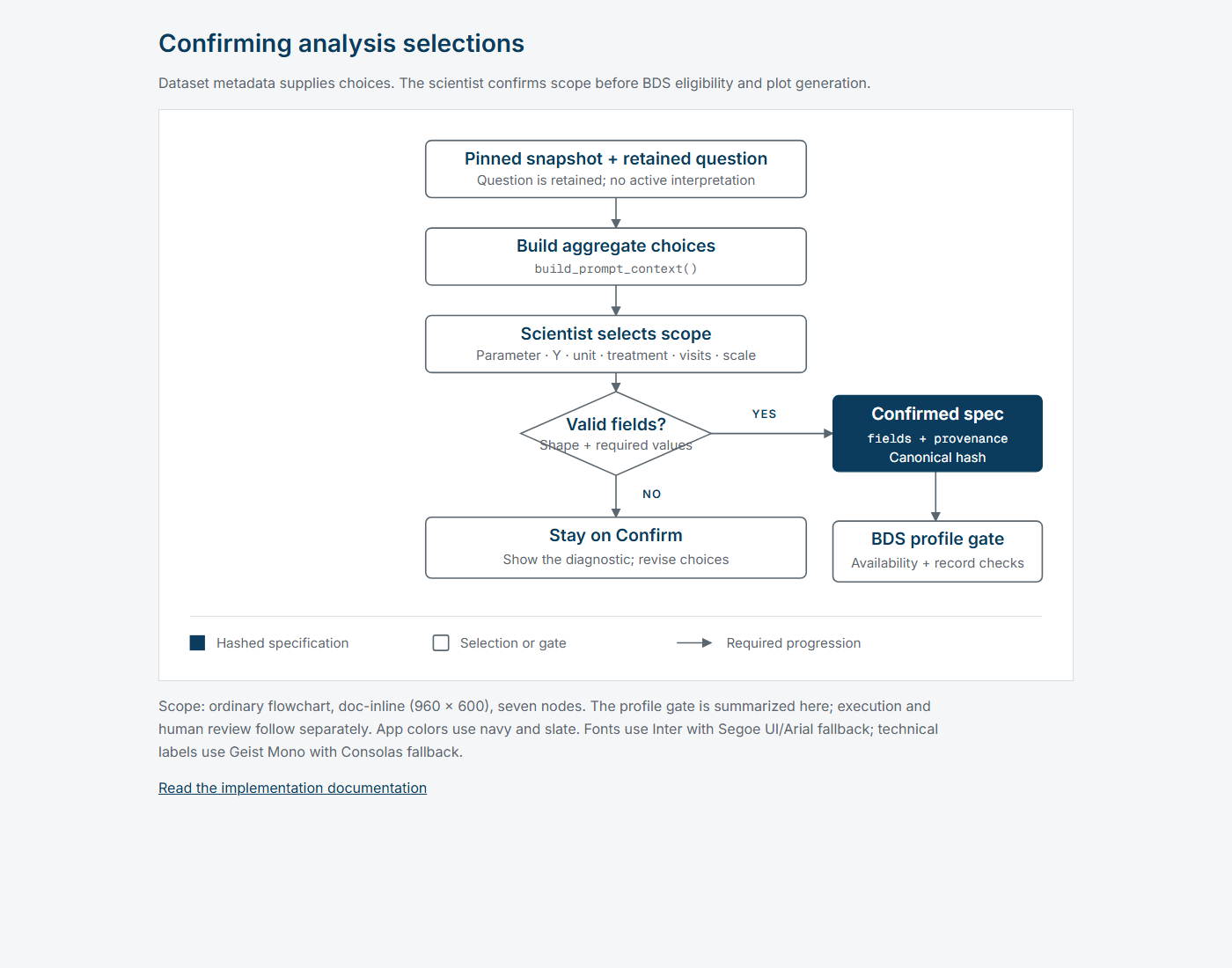
The diagram shows the selection and field gates; detailed BDS eligibility checks are described in BDS data profiling.
From question to selectable choices
In mod_plot_generation.R,
to_confirm requires the current upload and a valid
question. It calls .create_assurance_candidate() in app_server.R
when there is no pending candidate or the question has changed. That
function pins the snapshot, retains the question, builds aggregate
context, and creates a candidate with dataset_id set and
scale_mode = "fixed". The remaining plot fields initially
contain NULL.
build_prompt_context() in prompt_context.R
derives the following choices:
| Choice | Dataset source and ordering |
|---|---|
| Parameter |
PARAMCD, with PARAM supplying the
aggregate label; parameter rows sort by code. |
| Unit | Distinct non-missing AVALU values for each parameter,
sorted with radix ordering. |
| Y variable | Existing columns from AVAL, CHG, and
PCHG, in that order. |
| Treatment facet | Snapshot permitted_treatment_variables; each variable
has sorted distinct non-missing levels. |
| Visit | Distinct non-missing AVISIT/AVISITN pairs,
ordered by AVISITN, then label. |
.spec_choices_from_context() converts this context to UI
choices. The parameter control displays codes, and the visit control
displays labels. Treatment and visit choices are initially dataset-wide;
selecting a parameter does not rebuild them from that parameter’s
records. The later profile gate checks whether the selected combination
exists.
The context contains aggregate choices rather than patient records.
prompt_context_policy.R
rejects specified prohibited terms and URL patterns in labels and
aggregate content. This lexical check does not qualify uploaded data
provenance or establish de-identification. A separate
.create_assurance_revision() helper invokes a mock
interpreter, but the active upload candidate path does not call it.
What the scientist confirms
mod_specification.R,
through mod_specification_server(), presents the supported
longitudinal numeric BDS boxplot and its controls. Parameter, Y
variable, and treatment facet fall back to the first available choice
when the specification has no value. Visits and treatment levels
initially include all available choices. Fixed Y scales are the
default.
Units depend on the selected parameter. The control preserves an
available current unit, selects the sole available unit, or supplies an
empty selection when there are several units and no valid current
choice. .current_spec_input_fields() assembles the current
inputs with specification and choice fallbacks. The server validates the
submitted values; the controls alone are not the enforcement
boundary.
Selecting AVAL, CHG, or PCHG
chooses a stored column. Confirmation does not calculate change or
percent change, convert units, derive treatment assignments, or silently
apply analysis flags. Visit order comes from AVISITN,
rather than the order in which the scientist checks labels. Free Y
scales require the explicit acknowledgement checkbox before either
generation or correction can proceed.
Specification, provenance, and profile gate
.confirmed_spec_from_fields() requires one non-empty
parameter, supported Y variable, non-empty unit, and treatment variable.
Treatment levels and visits must each contain at least one unique
non-missing character value. It records dataset_id
provenance as metadata and all seven remaining field
sources as user_confirmed, including defaults accepted by
the scientist.
domain_plot_spec.R
defines eight specification fields: dataset_id,
paramcd, y_variable, unit,
treatment_variable, treatment_levels,
visits, and scale_mode.
new_plot_spec() records schema version
plot-spec-v1 and hashes the fields together with
provenance. confirm_plot_spec() requires non-NULL fields
and provenance for every field, then changes the state to
confirmed. Confirmation itself does not change that
hash.
The domain constructor accepts provenance labels prompt,
metadata, default, and
user_confirmed. Those labels describe the recorded source;
they are not signatures or authenticated proof of a person’s decision.
The active field builder imposes stronger shape checks than
confirm_plot_spec() alone.
The workflow then calls validate_bds_profile() in bds_profile.R.
This gate checks selected parameter and unit availability, permitted
treatment, numeric Y, treatment levels, visit availability and mappings,
and the supported record keys. A blocked profile remains on Confirm with
a diagnostic and prevents materialization. Field completeness therefore
does not imply plotting eligibility, full ADaM conformance, successful
execution, or human approval.
Revisiting choices and implementation evidence
Generated settings are read-only when there is no pending candidate
and the revision is not eligible for correction. Result can return to
Confirm and then back to Result. For Rejected or
Reviewed revisions with retained choices, the module offers
a correction action requiring rationale and provenance; it creates a
successor rather than editing the previous revision.
Inspected tests cover field/provenance display, read-only controls, user-selected units and visits, free-scale acknowledgement, and correction requests in test-mod-specification.R. test-domain-plot-spec.R covers complete and incomplete specifications, supported Y variables, and unknown provenance fields. test-prompt-context.R covers aggregate context and prohibited content. test-bds-profile.R covers explicit units, exclusions, numeric Y, and deterministic visit mappings.
These are inspected coverage references. This documentation task did not run R tests, browser journeys, statistical review, or formal validation.