Reproducing plots from retained inputs and execution records
Source:vignettes/articles/08-reproducing-retained-results.Rmd
08-reproducing-retained-results.RmdThe separately callable reproducibility service reruns a revision’s retained R script against its retained selected records and compares the new result with stored identities. Replay does not run automatically during confirmation, human review, or export. It returns evidence for a caller to inspect; it does not promote a revision, replace its accepted artifacts, or approve a plot.
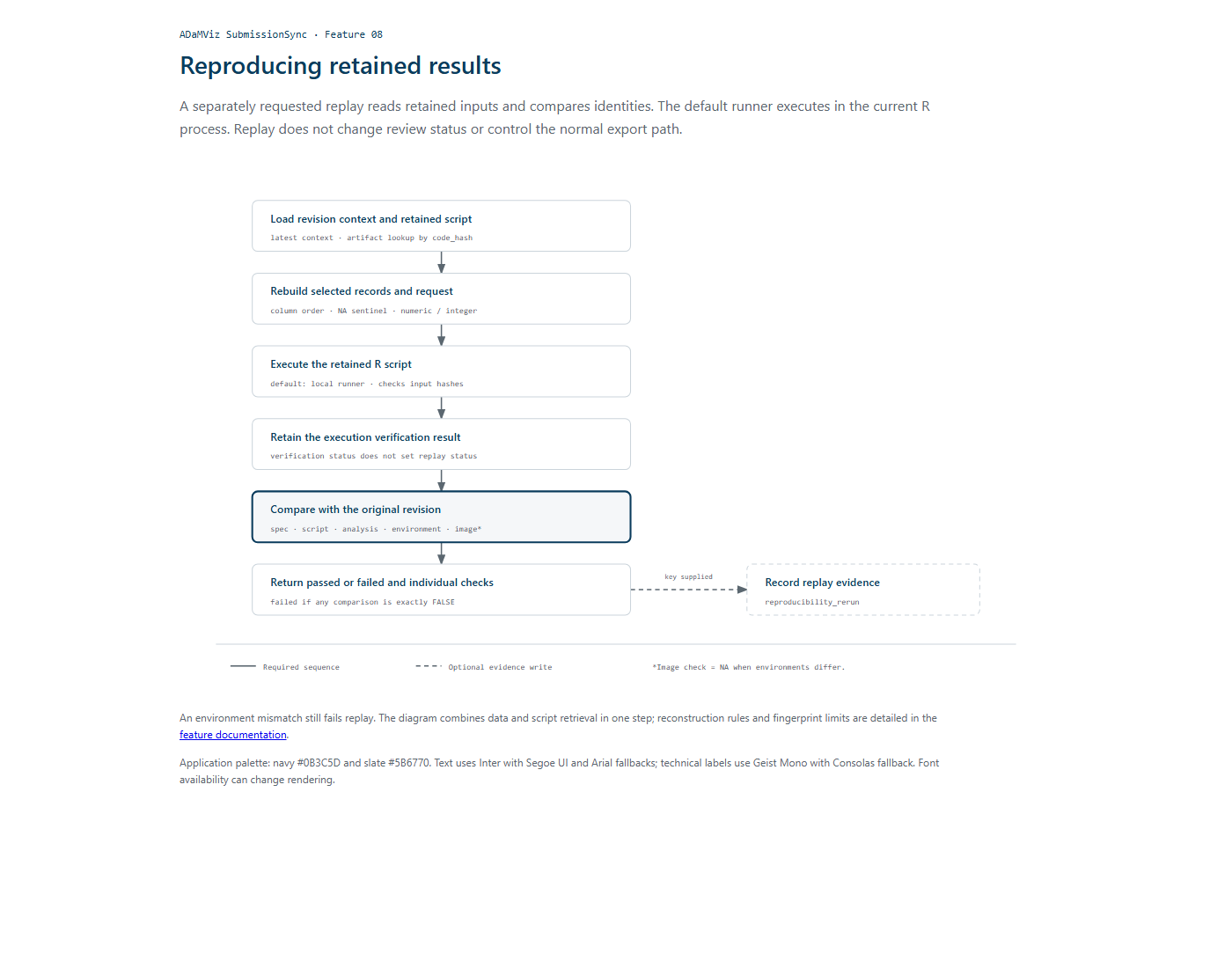
The diagram shows the service sequence and optional evidence write. Details of data reconstruction and comparison rules follow below.
What replay reads
new_reproducibility_service()
accepts an evidence repository, readable artifact store, runner, and
verification service. Its
reproduce_revision(revision_id, idempotency_key = NULL)
method retrieves the persisted revision and its latest
revision_context entry. Missing context stops the
operation. With the SQLite repository, entries are ordered by
created_at, then evidence_id; “latest” means
the last matching row in that order.
.revision_context_details()
retains the question, confirmed specification, input identity, selected
records, generated script, execution request and result, environment,
profile warnings, and checks. Replay reads the script bytes from the
artifact store using the revision’s code_hash, rather than
recompiling the specification or using the script copy in context JSON.
The local
store verifies an artifact’s SHA-256 hash before returning its bytes
through get().
The retained request supplies the original specification hash, script
hash, snapshot identity and hash, and harness version. Replay restores
its execution_request class directly. It does not call the
request constructor again or re-confirm plotting choices.
Reconstructing selected data
.evidence_selected_data() rebuilds a data frame from
input_data$selected_data. It flattens list-valued columns,
restores selected_data_columns order when recorded, and
otherwise uses the retained column names. Row values retain their stored
sequence.
The helper converts every value equal to the literal string
"NA" to an R missing value. It then restores recorded
numeric and integer columns using as.numeric() and
as.integer(). Recorded class names may be normalized by
stripping their prefix through the last dot; positional names are used
when class names are absent and counts match.
This is limited reconstruction, not a general R-object serializer.
Factors, dates, custom classes, and attributes are not explicitly
restored. A genuine character value "NA" can become
missing. Those differences can make the reconstructed input fail the
runner’s snapshot-hash check. Retaining a class label alone does not
guarantee that every input type can be recreated.
Running and checking the result
The default replay runner is new_execution_runner(),
which executes locally in the current R process. The normal governed
execution path uses a clean callr subprocess, described in
script generation and
execution. A caller can inject a different runner into replay; the
default does not recreate an isolated or locked historical
environment.
The runner receives the retained request, script, reconstructed
analysis_data, and recorded classification. If
classification was omitted, replay passes "synthetic". This
default does not establish synthetic provenance. The local runner
accepts synthetic or de-identified classifications and checks script and
data hashes against the immutable request before execution.
Replay invokes the verification service and retains its result. It then calculates a separate comparison set:
| Check | Comparison |
|---|---|
specification |
Retained request specification hash equals the revision specification hash. |
generated_r_code |
SHA-256 of replayed script text equals the revision code hash. |
analytical_result |
New analytical hash equals the revision analytical hash. |
environment |
New environment fingerprint equals the recorded context fingerprint. |
image_bytes |
New image hash equals the revision image hash, only when fingerprints match. |
An environment mismatch makes environment false and sets
image_bytes to NA. The overall result still
fails because the environment comparison failed. The fingerprint covers
recorded R/platform/OS details, versions of the application,
ggplot2, and patchwork, graphics device, and
image dimensions. It is not a complete environment lock or inventory of
every font, library, dependency, or operating-system setting.
The returned revision_reproducibility_result has status
failed when any comparison is exactly FALSE;
otherwise it has status passed. Its embedded
verification$status does not participate
in that calculation. Callers therefore need to inspect both comparison
and verification results. See execution verification and
revision evidence for the separate execution checks. Hash agreement
does not independently establish statistical correctness.
Recording and using replay evidence
Supplying an idempotency_key records a
reproducibility_rerun entry containing the result and its
outcome. Omitting the key returns the result without that evidence
write. The key controls repository command deduplication; the service
still runs the script before attempting the write on every call.
There is no revision-status prerequisite in this method and no normal UI replay gate. Replay neither changes review status nor records a new governed execution attempt. Its practical prerequisites are available context, accessible script bytes, reconstructable records, and a runnable environment.
Coverage and limits
test-revision-evidence.R
checks retained context and a passing replay with recorded evidence. Its
injected runner sources the script but writes fixed
"png bytes"; that test does not demonstrate real PNG
reproducibility or clean-subprocess behavior. The tests were inspected
for this document and were not executed. Source inspection also
identifies the reconstruction and status-calculation limits above; no
browser or regulated validation claim follows from this
documentation.