Evidence integrity, lifecycle history, and backup and restore
Source:vignettes/articles/12-integrity-lifecycle-backup.Rmd
12-integrity-lifecycle-backup.RmdThe local evidence repository retains revision history and checks relationships between records, lifecycle events, and stored artifacts. Its backup and restore functions operate on that local evidence package. These mechanisms detect several forms of local modification; they do not establish qualified audit-record custody or a durable study repository.
Records and identity
sqlite_evidence_repository()
stores plots, revisions, attempts and outcomes, evidence entries,
accepted artifact bundles, reviewer decisions, export receipts, command
keys, and a status/version projection. Numbered SQL
migrations apply in version order and record successful versions in
schema_migrations. Foreign keys are enabled for each
repository connection. SQL constraints enforce revision numbering,
permitted status and decision values, unique command/event keys, and
record relationships.
canonical_serialize()
and canonical_hash() sort named list elements
recursively and serialize compact JSON before hashing. Evidence details
have a SHA-256 content hash. Reviewer decision records have a separate
hash tied to a lifecycle event. These hashes serve different purposes; a
lifecycle chain does not contain every repository row.
local_artifact_store()
stores raw bytes at
<root>/<first-two-hash-characters>/<sha256>.
put() writes to a temporary file, checks its bytes, and
moves it into place. Existing objects are verified before reuse.
get() verifies an object’s hash before returning its bytes.
Code and image artifacts therefore have byte-level identity independent
of their display filenames.
Lifecycle writes and recovery
.append_lifecycle_event() creates a per-plot sequence
spanning its revisions. Each event binds the plot and revision
identifiers, sequence, event type, serialized payload, previous hash,
and timestamp. The first event starts from a 64-character zero hash. A
separate chain-root.json records the latest sequence and
chain hash for each plot.
Repository commands use .with_repository_lock(): a
companion SQLite .lock database holds a
BEGIN IMMEDIATE transaction while the operation runs.
Repository writes use database transactions. Lifecycle transitions
compare expected_version with the current projection, so
stale commands fail. Idempotency keys bind a canonical command hash:
repeating the same command is tolerated, while reusing its key for
different content fails.
The database transaction completes before the sidecar root is published. If publication fails, an exact replay of the previously registered command can reconcile the root. A new lifecycle command is blocked while roots disagree. Reconciliation refuses a root that is newer than the database or conflicts at the same sequence. This addresses a recoverable publication failure without silently accepting arbitrary rollback.
rebuild_projections() reconstructs revision status and
version from initial statuses and ordered lifecycle payloads. It
replaces the status projection; it does not reconstruct missing
evidence, artifacts, attempts, reviewer decisions, or export receipts.
Historical revision update and deletion methods explicitly reject those
operations. Direct filesystem or SQL access remains outside these API
restrictions.
What integrity verification checks
verify_integrity() checks foreign keys; per-plot event
order and chain hashes; sidecar roots and persisted plot membership;
reconstructed status/version projections; evidence-detail hashes;
accepted-bundle hashes against revision hashes; reviewer hashes,
decision identifiers, and lifecycle bindings; and receipt code/image
hashes against revision hashes. When an artifact store is attached, it
also verifies referenced code and image bytes.
require_artifacts = TRUE rejects a nonempty revision
repository without an artifact store. The default is FALSE.
The verifier does not independently recalculate plotting statistics,
authenticate reviewers, or compare exported workspace files with
receipts. Its evidence-entry hash checks do not prove that every
expected evidence record exists. Analytical hashes are checked as
recorded relationships, rather than through a separate content-addressed
analytical artifact check.
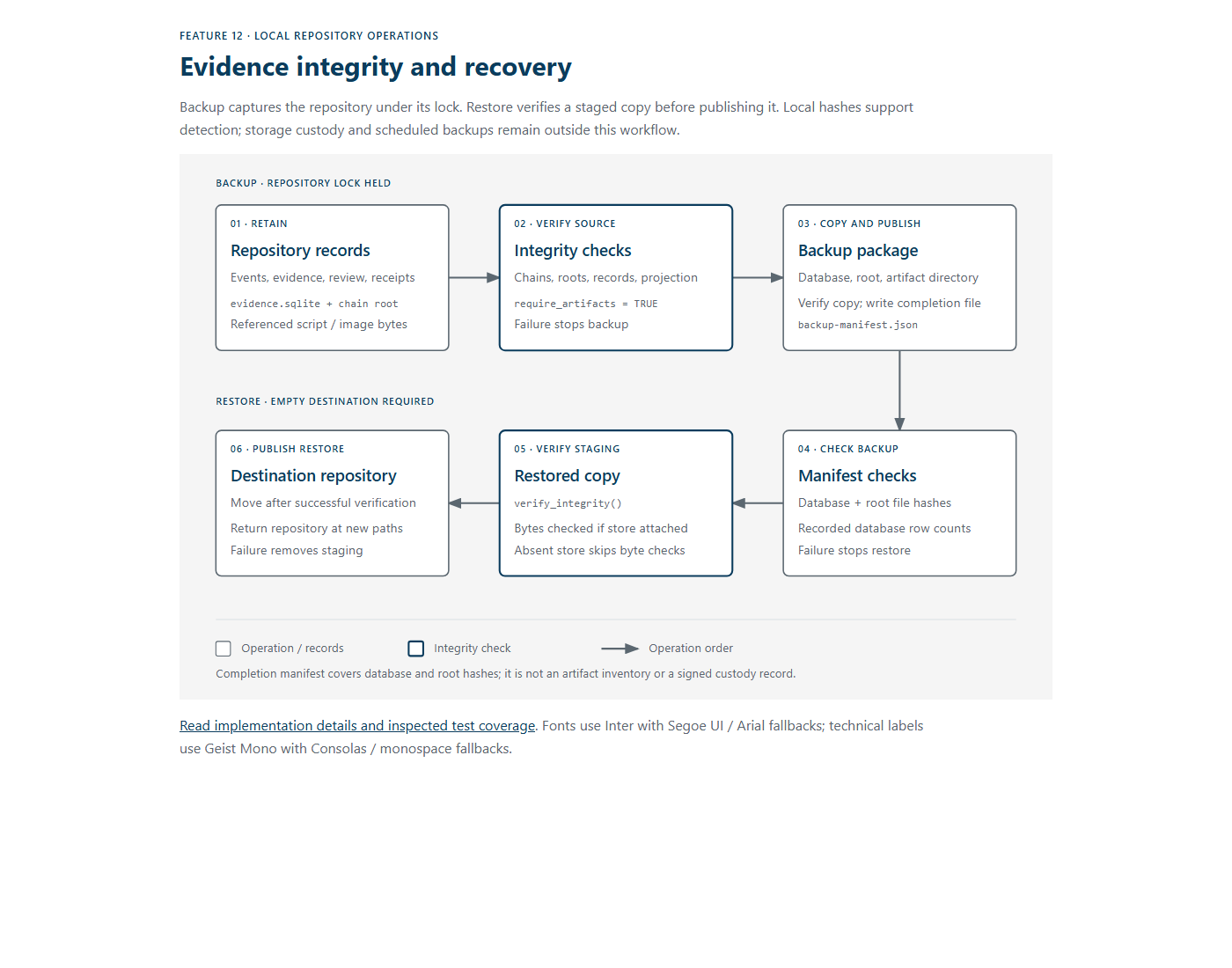
Backup and restore sequence
backup(destination) requires an empty destination, holds
the repository lock, and verifies source integrity with
require_artifacts = TRUE. It stages a database copy using
RSQLite::sqliteCopyDatabase(), copies or creates the
sidecar root, and copies the artifact directory when attached. The
staged repository is verified before publication.
backup-manifest.json records the database SHA-256,
chain-root SHA-256, table row counts, and completion timestamp. It does
not enumerate or hash every artifact file and does not sign the package.
The staged directory moves into the destination after verification and
manifest creation. A failed operation removes its staging directory.
restore_evidence_repository(backup_path, destination)
checks the completion manifest, database/root hashes, and recorded row
counts before copying into a new staging directory. It attaches an
artifact store when the backup contains an artifacts
directory, verifies the staged repository, and publishes to an empty
destination only after success. It returns a repository pointing at the
restored paths.
Restore coverage gap: restore calls
verify_integrity() with its default argument. If the
complete artifact directory is absent, no artifact store is attached and
metadata verification can proceed. Corrupt referenced bytes in a present
artifact directory are detected. The manifest therefore does not
establish that a restored package contains all artifact bytes.
Cleanup and operational limits
cleanup_orphan_artifacts(minimum_age_seconds = 3600)
locks the repository and preserves code/image hashes referenced by
revisions. Cleanup considers only files matching the two-level
content-addressed layout and removes unreferenced files old enough to
meet the threshold. It does not implement evidence retention or study
deletion. Its reference scope is the attached repository; sharing an
artifact root with another repository would not protect that other
repository’s references.
The application
coordinator uses a temporary assurance-session- root
unless repository_root is supplied. Backup, restore,
cleanup, and recovery exist as callable operations; no automatic
scheduled backup or cross-session discovery is established by this
workflow. Persistent storage configuration, retention policy, access
control, independently protected roots, and qualified target-environment
custody remain unresolved.
Inspected test coverage
Repository tests cover chain corruption, event omission, root rollback, projection rebuilds, evidence/decision modification, publication retry, command reuse, migrations, serialized writes, and pending artifact-hash binding. Artifact tests cover corruption, reference-preserving cleanup, layout filtering, and resolved roots. Backup/restore tests cover round trips, modified/incomplete backups, concurrent lifecycle writes, empty repositories, required artifact reconciliation during backup, and corrupt artifact bytes during restore. These tests were inspected, not executed for this documentation change.
Related: execution evidence, correction traceability, and controlled export.