Deterministic R script generation and subprocess execution
Source:vignettes/articles/06-script-generation-execution.Rmd
06-script-generation-execution.RmdThe fixed-scale plotting path compiles a confirmed specification into application-owned R code, then runs that code synchronously in a separate R process. The script, selected records, specification, and execution harness have recorded identities. A completed worker run supplies evidence for verification; it does not establish statistical approval or human review.
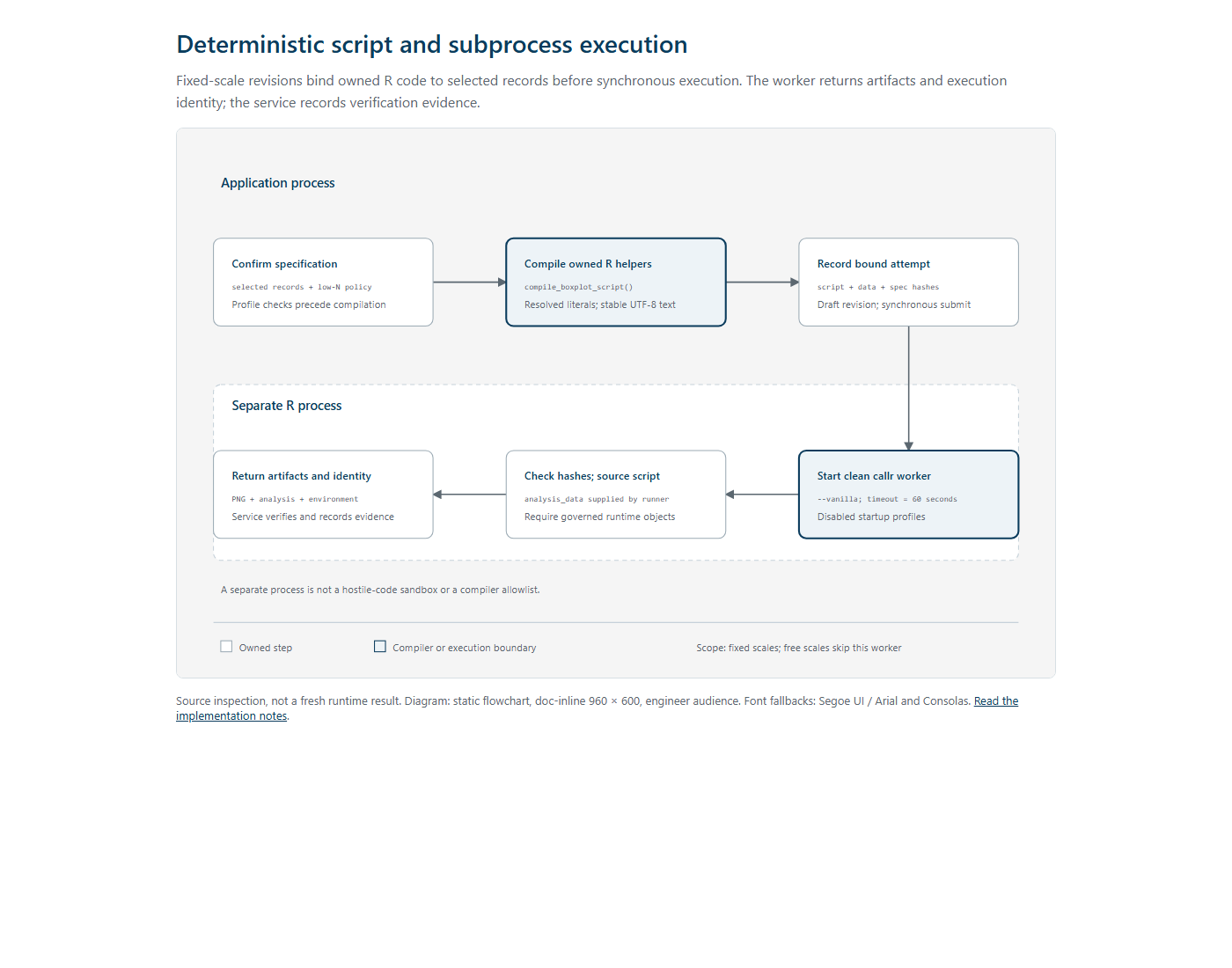
The diagram shows the fixed-scale path. Free-scale previews and detached script use are described below.
From confirmation to executable code
compile_boxplot_script()
validates the plot_spec, requires
state = "confirmed", and checks the ordered treatment and
visit levels plus retained low-N policy. It constructs R expressions
from owned helper functions and resolved specification literals using
rlang::call2() and rlang::expr().
rlang::expr_text() writes those expressions at width 80.
The resulting script is UTF-8 text with a final newline.
The emitted code contains the standalone statistical and plotting
functions from boxplot_standalone.R.
It inserts the treatment variable, Y variable, ordered levels, scale
mode, unit, and low-N policy into the analysis call. This avoids relying
on the application package for those functions when the detached script
is used elsewhere. The active upload workflow retains the user’s
question but collects plotting choices through confirmation. Its
execution path uses this compiler; it does not execute an LLM-generated
script.
For unchanged compiler helpers, specification fields, policy, and rendering dependencies, repeated compilation produces identical text. This is a script-generation guarantee within that implementation, rather than a promise of identical bytes across compiler or package upgrades. Revision identifiers in the coordinator include time, and PNG identity depends on the execution environment. Neither follows from identical generated text alone.
Binding the selected input
In app_server.R,
.materialize_revision() compiles the script and constructs
an execution request with the specification hash, script hash, snapshot
identifier, hash of profile$selected_data, and
execution-harness-v1. The request’s snapshot hash
identifies the selected execution records, not the entire original
upload.
new_execution_request()
requires non-empty identity fields. Before sourcing the script,
.validate_execution_input() in execution_runner.R
recomputes the script SHA-256 and canonical data hash and rejects
mismatches. The worker places the selected records in its evaluation
environment as analysis_data. Consequently, the generated
fallback CSV loader is skipped during governed execution.
The local runner accepts classification strings
synthetic and deidentified. The service
defaults to synthetic, and the coordinator does not pass a
separately established upload classification. This check validates the
supplied label; it does not prove synthetic provenance or
de-identification.
What the subprocess executes
new_execution_service()
records an attempt before calling the runner. Only Draft
revisions can start, and the service prevents another active attempt
with a different attempt identity for the same revision. Its fingerprint
combines the request, supplied script hash, and selected-data hash.
run_execution_callr()
invokes callr::r() synchronously with
--vanilla, disabled system and user profiles, and the
current library paths. It clears R_PROFILE_USER,
R_ENVIRON_USER, and ADAMVIZ_SECRET_CANARY. The
default timeout is 60 seconds and is configurable through the runner
constructor. Timeout or subprocess errors become failed runner results.
There is no user cancellation control in this path.
The worker can load the active source checkout with
devtools::load_all(), using the configured source root, an
ancestor containing DESCRIPTION, or the installed package
location. It then calls run_execution_locally(). That
function writes script.R, sources it in an environment
containing analysis_data, and requires
boxplot_analysis and boxplot_artifact objects.
It saves the combined plot as a Cairo PNG, defaulting to 1200 by 840
pixels, and rejects an absent or empty image.
Successful results return the analytical object, image location and
hash, request-bound result manifest, environment details, and
diagnostics. The environment record includes R, platform, operating
system, selected package versions, device, and dimensions. Local
diagnostics default to a 4000-byte threshold; subprocess error messages
pass through the separate callr error handler. The
coordinator writes evidence and accepts artifacts after
verification.
Enforcement limits and detached use
The worker sources the supplied script. Hash binding detects a script changed relative to its request; it does not independently prove that the script came from the compiler. The runner has no compiler allowlist, hostile-code sandbox, or demonstrated complete environment-variable allowlist. Process separation and disabled startup profiles should not be described as those controls.
The generated script installs missing ggplot2,
cli, and patchwork packages from CRAN without
pinning their versions. If analysis_data is absent, it
reads a checkout-specific synthetic CSV path. Detached execution
therefore requires suitable data and dependencies; the fallback path is
not portable. The active free-scale path still compiles a script and
constructs an application-process preview, but skips governed subprocess
submission and remains Experimental/Draft. The normal UI
preview is reconstructed in the application process rather than read
from the accepted worker PNG.
Inspected checks and remaining evidence
The inspected tests cover stable parseable scripts and analytical fixtures, subprocess execution and source-root selection, runner manifests and rejection cases, service promotion and terminal failures, and execution manifest identity. Graphics and package availability can cause skips in the subprocess tests.
This documentation records source and test inspection. It does not report a fresh R test run, browser execution, statistical sign-off, or target-environment qualification.