Fixed and free Y scales
Source:vignettes/articles/05-fixed-free-y-scales.Rmd
05-fixed-free-y-scales.RmdFixed Y scales use the governed execution path. Free Y scales require
an explicit acknowledgement and create an
Experimental/Draft revision with a generated script and an
in-process preview. The free-scale revision does not receive a governed
subprocess attempt, execution verification, human review, or controlled
export.
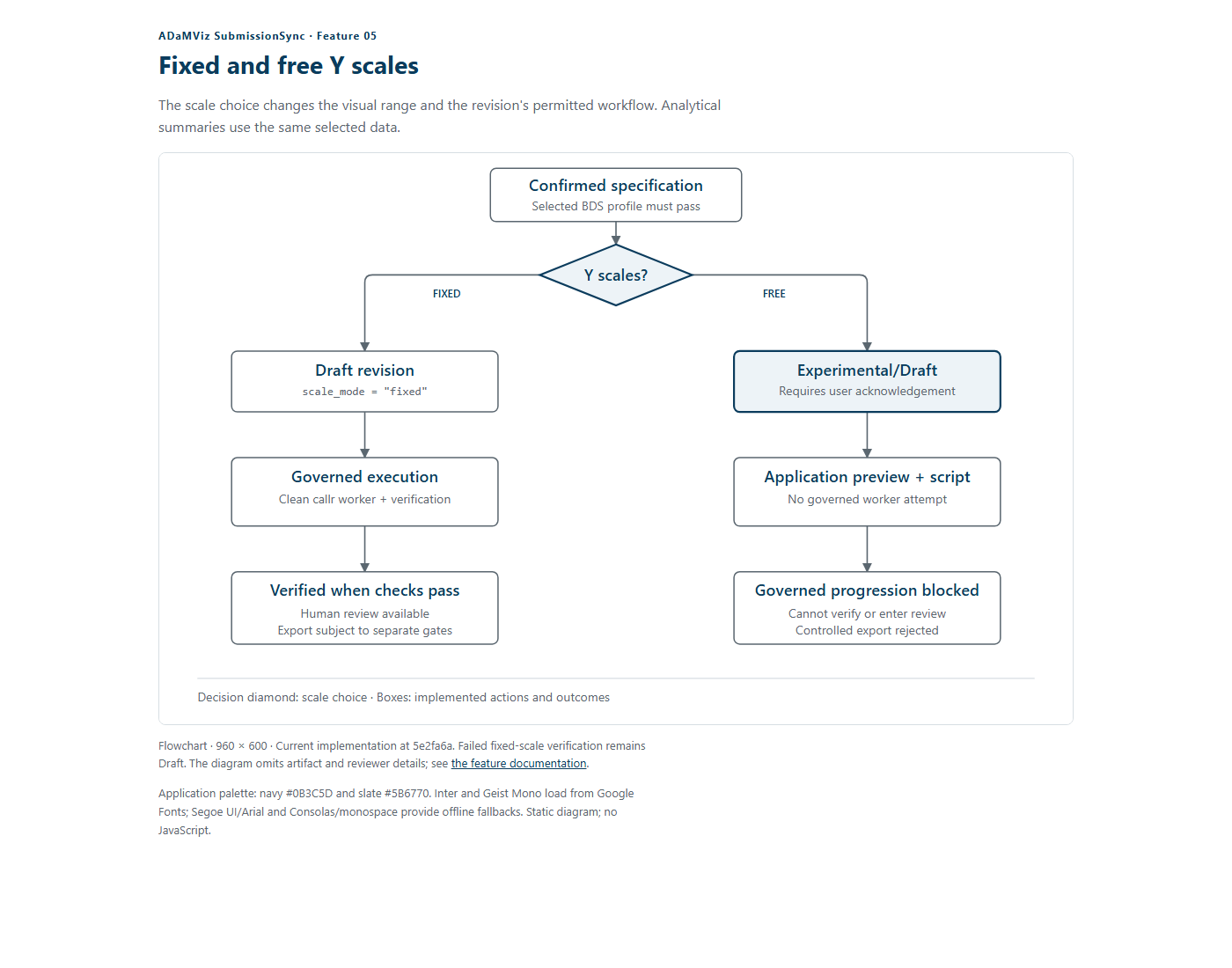
The diagram shows current implementation, inspected at commit
5e2fa6a; it does not establish runtime or statistical
validation.
Choosing a scale
The Confirm controls offer Fixed and Free,
with fixed as the fallback when the specification has no scale choice.
The scientist also confirms one parameter, unit, stored Y variable,
treatment variable, treatment levels, and visits. Both scale modes go
through the selected BDS profile checks before materialization. A free
scale does not relax the input envelope or permit otherwise invalid
selections.
mod_specification_server() checks the acknowledgement
before invoking either generation or correction. If the scientist
selects free scales without checking “I understand free Y scales create
an Experimental/Draft revision”, the module displays a message and
returns without calling the action. This is a UI confirmation check: the
checkbox itself is not a field of the confirmed plot specification. The
separate mock-prompt coordinator also checks free-scale confirmation,
but it is not the active upload workflow’s prompt interpreter.
Source: specification module, application coordinator, and plot specification.
What changes in the figure
assemble_boxplot() passes scales = "fixed"
or scales = "free_y" to ggplot2::facet_wrap().
Fixed scales give the treatment facets a common Y scale. Free scales
allow each treatment facet to use its own Y range. Consequently, similar
vertical positions across free-scale facets need not represent similar
analysis values; the artifact carries the warning “Free Y scales weaken
cross-facet visual comparison.”
The scale choice does not enter
calculate_boxplot_statistics(). With the same selected
records and plotting choices, both assemblies use the same boxes, median
connections, outliers, and distinct-subject N. Visit positions remain
globally ordered, and the aligned N strip uses its own fixed display
range. This distinction matters when comparing treatment magnitudes: a
change in apparent separation can come from the axes while the
analytical values remain unchanged.
The generated standalone assembly helper uses the same fixed/free
mapping and experimental warning. compile_boxplot_script()
embeds the confirmed scale value as a literal in its assembly call, so
the choice is part of the specification and script identities.
Source: plot assembly, standalone helper, and compiler.
Execution and evidence boundaries
.materialize_revision() compiles the script, builds an
execution request, stores the script bytes, and creates the repository
revision for either mode. A fixed-scale revision starts as
Draft. The coordinator submits it to
new_execution_service(), which runs the script in the clean
callr worker. Passing verification accepts the artifact
bundle and promotes the revision to Verified; failed
verification leaves it Draft.
A free-scale revision starts as Experimental/Draft. The
coordinator skips submission, leaves verification as
NULL, and calculates the displayed analysis and plot in the
application process. It also skips
.record_revision_context(), because that call depends on a
non-null verification result. A stored script and visible preview
therefore do not imply the retained execution evidence available on the
fixed-scale path. .materialize_correction() makes the same
scale-based submission distinction for a successor revision.
new_execution_service() admits only Draft
revisions. .workflow_transitions gives
Experimental/Draft no outgoing status transitions.
Repository review decisions require Verified, and
.assert_exportable_revision() accepts only
Reviewed. Free-scale revisions fail those gates. Reviewed
status alone still does not guarantee export: the service also requires
accepted artifacts and the remaining export checks.
Source: execution service, status rules, review repository gate, and export service.
Checks and known gaps
The inspected tests specify the intended boundaries:
- Assembly tests compare analytical objects, shared versus separate panel scales, ranges, statuses, and the warning.
- Specification tests verify that an unconfirmed free-scale action does not call generation and that acknowledgement allows the callback.
- Execution tests reject an experimental submission and assert that no attempt was recorded.
-
Export
tests reject an
Experimental/Draftrevision. Status tests cover its initial status.
These tests were read, not executed, for this documentation change. No R execution, browser journey, statistical review, or formal validation is claimed.
The Result panel labels its script disclosure “Executed R script” for
both modes, even though the experimental script was not submitted to the
worker. The preview also renders state$artifact$combined,
reconstructed in the application process, rather than the accepted
worker PNG. Those are current presentation limits, not evidence that the
free path is governed. The proof of concept is designed for validated
clinical submission workflows; it is not FDA validated or FDA
approved.
Source: preview module. Related documentation: statistical summaries, script execution, and controlled export.