Architecture and implementation boundaries
Source:vignettes/articles/architecture.Rmd
architecture.RmdADaMViz SubmissionSync is an R-first, package-oriented Shiny proof of concept for clinical scientists, supported by statistical programmers and biostatisticians. It connects permitted input data, confirmed plotting choices, generated R code, plot artifacts, automated evidence, reviewer decisions, and export receipts.
It is designed for validated clinical submission workflows; it is not FDA validated or FDA approved. Intended-use validation belongs to the regulated organization.
Diagrams
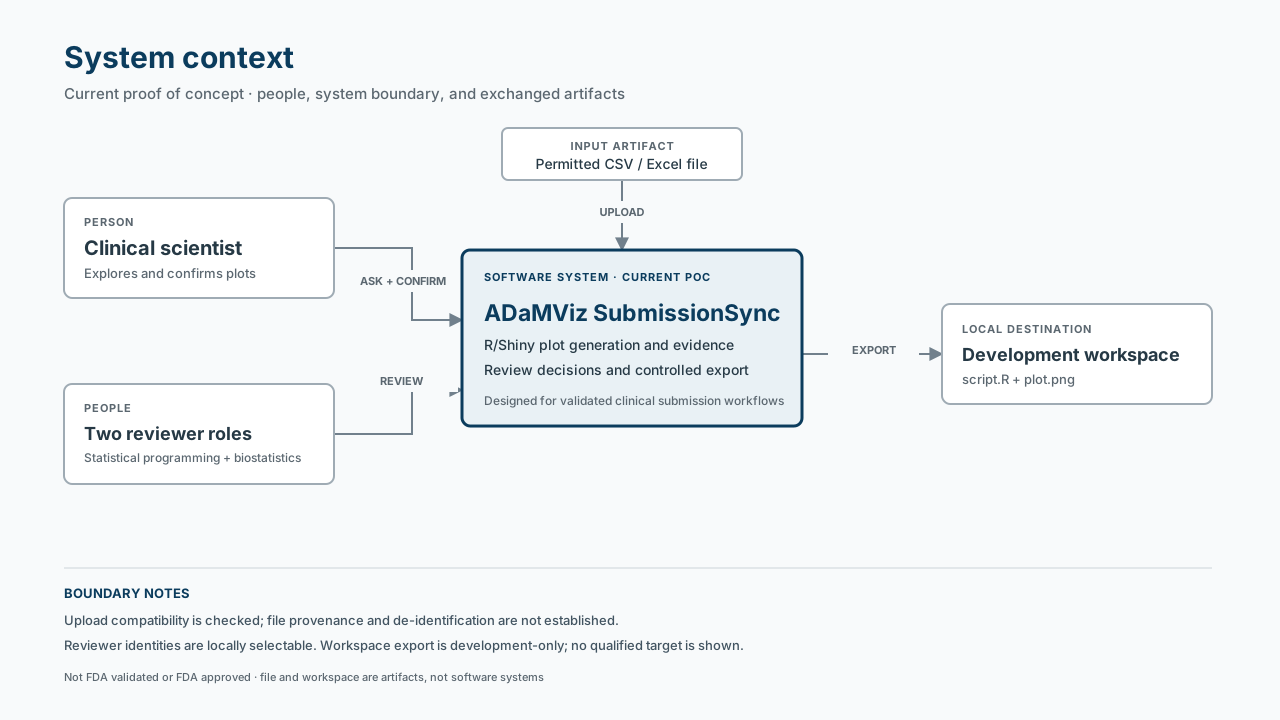
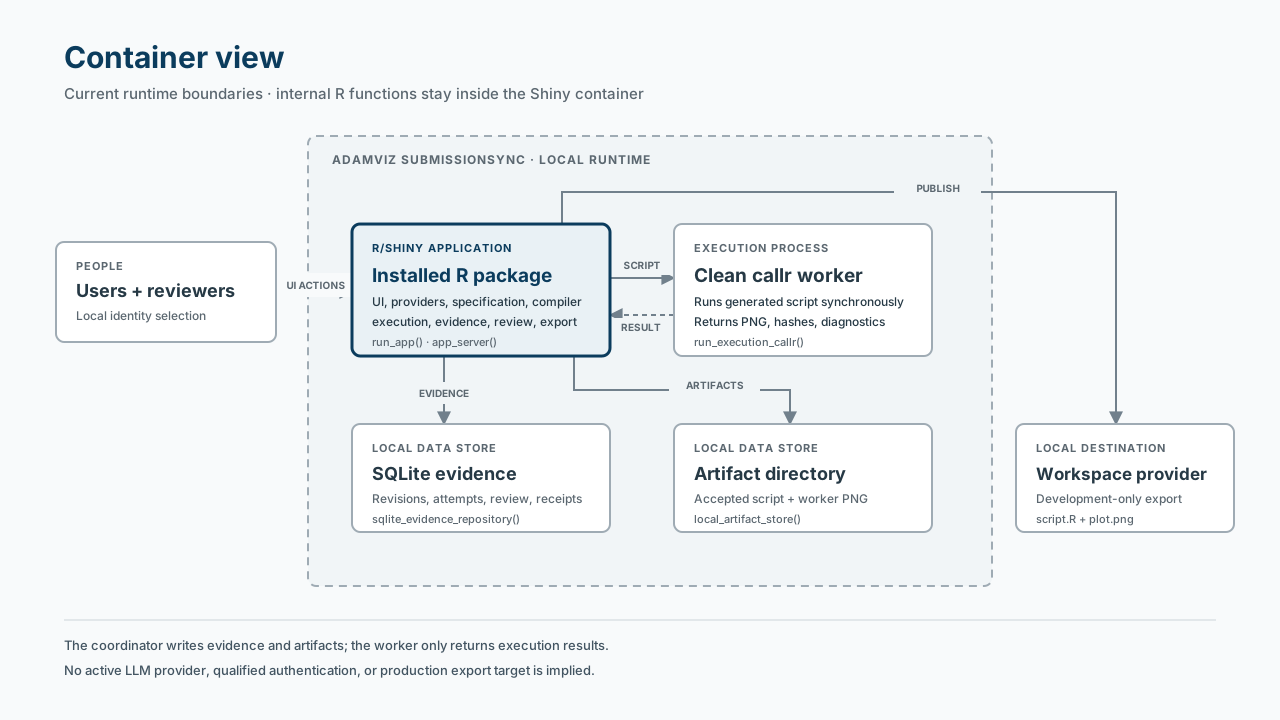
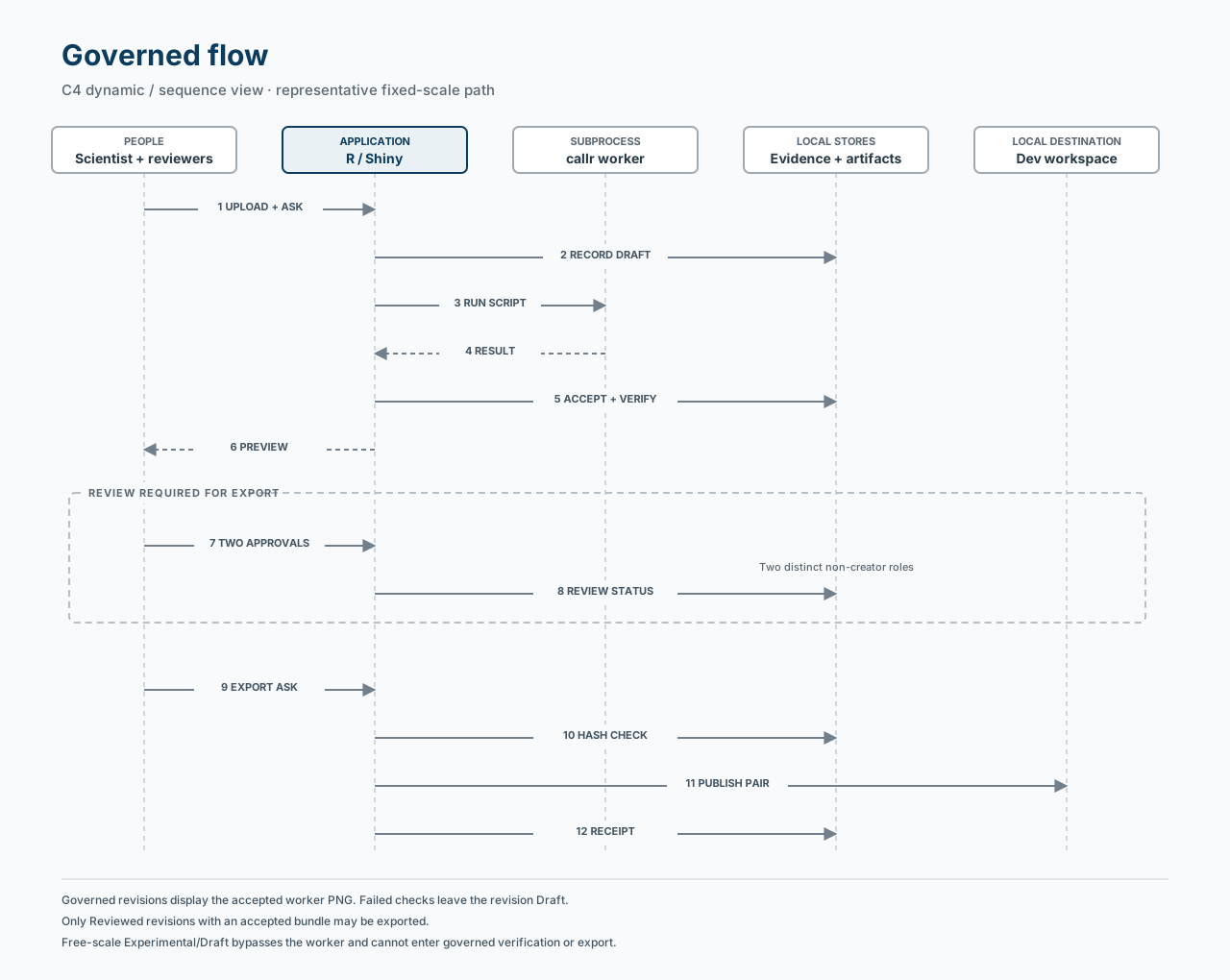
The diagrams show the current proof of concept. They are visual guides to the code and the implementation limits described below.
System context — people, the application, permitted input, and the local development export. Open full-size view.
Container view — the Shiny application, clean
callr worker, local stores, and development workspace. Open full-size
view.
Governed flow — a representative fixed-scale sequence, with optional human review and the code’s export gate. Open full-size view.
Current scope
The implemented plotting pattern is a longitudinal numeric BDS
boxplot: one parameter, unit, and stored Y variable (AVAL,
CHG, or PCHG), ordered analysis visits,
treatment facets, median connections, visible outliers, and
distinct-subject N.
The active interface follows Data → Ask → Confirm → Result →
Export. Inputs are CSV or Excel files; Excel parsing uses the
first worksheet. Outputs include a plot preview, generated R script,
revision evidence, review history, and a detached
plot.png/script.R export pair with an optional
ZIP download.
Implementation exists for deterministic generation, synchronous subprocess execution, local evidence persistence, review, correction revisions, and development-only workspace export. Privacy qualification, production authentication, and qualified target-environment controls are incomplete. A mock prompt interpreter exists separately; the active upload workflow collects the question but derives plotting choices from data and user selections rather than interpreting that question.
Persistent governed study context and broader table, listing, and figure support remain deferred.
Code map
Names below are exact symbols suitable for IDE symbol search.
| Component / physical location | Responsibility | Start here for common changes |
|---|---|---|
Root app.R; application functions under
R/
|
Launch the installed package and compose the Shiny application |
run_app(), app_ui(),
app_server()
|
R/mod_*; R/app_theme.R;
inst/app/www/
|
Workflow navigation, confirmation, preview, evidence, review, and export interface |
mod_plot_generation_server(),
mod_specification_server(), app_theme()
|
R/provider_study_data*; R/bds_profile.R;
upload adapter in R/mod_plot_generation.R
|
Read inputs, pin snapshots, expose choices, and validate the supported selected-data envelope |
.uploaded_study_data_provider(),
pin_study_snapshot(),
validate_bds_profile()
|
R/domain_*; R/prompt_*; canonical
serialization |
Specification, status, execution contracts, aggregate prompt context, and optional interpretation |
new_plot_spec(), confirm_plot_spec(),
interpret_prompt(), canonical_hash()
|
R/boxplot_* |
Statistics, plot assembly, and deterministic standalone script generation |
calculate_boxplot_statistics(),
assemble_boxplot(),
compile_boxplot_script()
|
Execution and verification files under R/
|
Coordinate attempts, run the script, check results, and perform separately requested replay |
new_execution_service(),
run_execution_callr(),
verify_execution_result(),
new_reproducibility_service()
|
Evidence, artifact, lifecycle, review, and export files under
R/; inst/sql/
|
Persist revision relationships and evidence; govern review and publication |
sqlite_evidence_repository(),
local_artifact_store(), new_review_service(),
new_export_service()
|
tests/testthat/; inst/schema/;
inst/extdata/synthetic/;
.github/workflows/
|
Behavioral tests, contract assets, governed synthetic fixtures, and package CI | Relevant test-* files,
synthetic_scenario_manifest(),
R-CMD-check.yaml
|
These components are conceptual groups within a flat
R/ directory, not separate packages or directory
layers. Provider contracts are classed lists of functions. The
application coordinator currently constructs several local
implementations directly.
app.R calls the installed namespace. Reading or editing
source does not by itself update the installed application.
End-to-end flow
| Stage | Current implementation |
|---|---|
| 1. Input and snapshot — implemented; privacy assurance partial |
.uploaded_study_data_provider() parses and checks
supported file structure, calculates file/content hashes, and creates
provider metadata. pin_study_snapshot() checks membership
and content identity. Direct uploads carry no classification; format
checks do not establish synthetic provenance or de-identification. |
| 2. Plot specification — implemented; interpretation integration partial |
.create_assurance_candidate() retains the question and
builds aggregate choices. mod_specification_server()
collects selections; .confirmed_spec_from_fields() creates
a confirmed specification with provenance. The active path does not call
interpret_prompt().
ellmer_prompt_interpreter() is disabled. |
| 3. Profile and compilation — implemented |
.execute_assurance_revision() validates the selected
BDS profile before compilation. Explicit selections govern inclusion;
analysis flags are not silently applied. Missing selected Y values are
excluded from display statistics while retained selected records remain
available for evidence. Blocking profile diagnostics stop generation.
compile_boxplot_script() emits application-owned R
code. |
| 4. Execution and artifacts — implemented | Fixed-scale revisions start as Draft.
new_execution_service() records an attempt and
synchronously invokes a clean callr subprocess. The worker
executes the supplied script with selected records as
analysis_data, returning analytical output, PNG identity,
environment details, and diagnostics. Passing service checks lead to
artifact acceptance and Verified; failed verification
leaves Draft. |
| 5. Preview, evidence, and replay — implemented with separate paths | Governed revisions display the accepted worker PNG and stored
script; experimental free-scale revisions retain an in-process preview.
Revision-context evidence retains the question, specification, selected
input records, script, execution metadata, and checks.
new_reproducibility_service() can rerun retained evidence,
but replay is not wired into the normal confirmation, review, or export
path. |
| 6. Review and correction — implemented with local identities | Two distinct active non-creator actors, covering
statistical-programmer and biostatistician roles, must approve identical
artifact hashes to reach Reviewed. Rejection creates
Rejected. Corrections to Rejected or
Reviewed revisions create linked successors with rationale
and provenance. UI identities are selectable local actors, not
authenticated users. |
| 7. Controlled export — implemented for development |
new_export_service() accepts only Reviewed
revisions with an accepted bundle. It checks actor eligibility, revision
version, destination, and artifact hashes around staging/publication,
then records an internal receipt. The local provider publishes only
script.R and plot.png; the ZIP packages the
last successful export. Qualified target-provider guarantees remain
deferred. |
Free Y scales require UI confirmation and produce
Experimental/Draft. The coordinator generates their script
and preview without submitting a governed subprocess attempt. They
cannot enter governed verification or controlled export.
Invariants and dependency boundaries
Enforcement labels describe existing mechanisms and test coverage, not a claim that tests currently pass.
| Boundary | Enforcement and limits |
|---|---|
| Only permitted POC data; no confidential patient-level data | Documented policy only for provenance. Runtime format/profile checks and automated tests exist, but direct uploads bypass classification and use the execution service’s synthetic default. |
| Secrets stay outside source, prompts, scripts, logs, and retained evidence | Documented policy, with runtime checks + automated tests for injected secret resolution. There is no demonstrated application-wide secret redaction or subprocess environment allowlist. |
| Prompt/model output must not become arbitrary executable R | Runtime checks + automated tests in the interpreter and confirmed-spec compiler. The active UI uses the owned compiler. The runner itself is not a hostile-code sandbox or an independent compiler allowlist. |
| Selected data must fit the supported plotting envelope |
Runtime checks + automated tests for required
fields, selections, visit mappings, duplicate keys, numeric Y, and
statistical input checks.
dataset_conformance = "not_assessed" explicitly avoids
claiming full ADaM conformance. |
Verified and human approval remain distinct |
Runtime checks + automated tests in the execution, repository, and review services. Repository promotion requires a successful attempt, linked passing verification evidence, and an accepted artifact bundle. |
| Review binds an immutable revision; correction creates a successor | Runtime checks + automated tests for reviewer roles, distinct identities, creator exclusion, hashes, stale versions, and correction relationships. Pending image/analytical hashes are bound once during artifact acceptance. |
| Evidence and artifacts retain identity | Runtime checks + automated tests for content-addressed artifacts, SQL relationships, command idempotency, lifecycle hash chains, integrity checking, and backup/restore. This is local integrity machinery, not qualified audit-record custody. |
| Replay preserves recorded identity | Runtime checks + automated tests in the separately callable replay service. Image equality depends on matching environment fingerprints. Replay is not an automatic review/export prerequisite. |
| Export uses accepted artifacts and registered logical destinations |
Runtime checks + automated tests in
export/workspace services. Only Reviewed revisions are
eligible. The development provider does not supply qualified filesystem
or access-control guarantees. |
| Stay within approved ggplot scope and R-based AI implementation |
Documented policy only in
CODEX_CONTEXT.md; no dependency-direction linter or CI
architecture rule was found. |
The worker returns execution results; the coordinating process writes evidence. Future model adapters must remain on the specification side of the compiler boundary and must not gain execution, review, or workspace-publication authority.
Cross-cutting concerns
Configuration and injection.
new_runtime_config() provides profile and logical
provider/workspace identifiers plus an injected secret resolver.
Services accept repository, runner, identity, artifact, and workspace
implementations. Injection is partial at application level: the
coordinator constructs local providers, and runtime prompt-provider
selection does not select an interpreter in the active workflow.
get_golem_config() exists separately from these runtime
defaults.
Errors and recovery. Boundaries use
checkmate and cli; modules expose caught
errors as messages. Execution failures produce failed results and
terminal attempt evidence. reconcile_execution_attempts()
and reconcile_workspace_exports() exist as callable
recovery functions, without automatic application startup wiring.
Observability and cancellation. Stored attempts,
timestamps, checks, review decisions, receipts, and worker diagnostics
provide operational evidence. The subprocess has a timeout. No user
cancellation control or strategy-metric telemetry pipeline was found;
schema outcome names such as cancelled do not establish
cancellation behavior.
Testing and continuous checks. Tests cover
functions, contracts, services, Shiny servers, and browser journeys.
Browser initialization can skip when unavailable. CI documents the
package, runs tests, and runs R CMD check. Its failure
threshold is errors; repository pre-commit policy additionally requires
formatting, linting, and failure on warnings.
Contradictions and open questions
- Data boundary: strategy permits public, synthetic, or properly de-identified data; the F001 design learning specifies synthetic-only use. Upload checks establish compatibility, not provenance. Which approved boundary and enforcement apply?
- Authentication: UX and threat-model wording assumes authenticated/session-derived actors; the current UI selects local identities.
- Verification meaning: runtime verification checks execution identity and manifest/hash properties. It does not independently establish statistical correctness or automatically rerun the revision.
- Artifact identity: governed revisions display the accepted PNG and stored script. Experimental revisions still use an in-process preview and have no accepted worker artifact.
-
Standalone portability: generated scripts require
callers to supply
analysis_dataand locked dependencies; detached exports intentionally do not include selected records. - Persistence and operations: the app creates evidence under temporary directories. Retention custody, cross-session discovery, automatic recovery, production monitoring, and target-environment qualification remain unsettled.
-
Document drift: workflow/product documents leave
lifecycle and supported-envelope questions open despite implemented
choices; the traceability matrix still marks implemented areas as
planned. The readiness report places
STRATEGY.mdat root, but its actual location isdocs/product/STRATEGY.md.
These observations identify differences; they do not authorize new requirements or refactoring.
Navigation and maintenance
The twelve feature guides explain the current input, profiling, plotting, execution, review, export, and evidence workflows. Each guide includes an implementation diagram and links to source and inspected tests.
| Task | Read before changing it |
|---|---|
| Scope, terminology, or product boundaries |
CODEX_CONTEXT.md,
docs/product/STRATEGY.md,
docs/product/product-contract.md,
CONCEPTS.md
|
| UI or workflow behavior |
R/AGENTS.md,
docs/ux/F001-plot-generation.md, relevant
docs/solutions/; compare the prototype for layout |
| Statistics, specification, or execution |
R/AGENTS.md, relevant implementation/tests, and
docs/plans/2026-09-06-0014-feat-plot-pattern-assurance-cell-plan.md
for design intent |
| Privacy, review, evidence, export, or deployment boundaries | Relevant code/tests and docs/validation/, especially
the threat model, retention, traceability, and target-environment
protocol |
| Test or verification changes |
tests/AGENTS.md and the relevant test family |
Plans, explainers, prototypes, and validation templates describe intent or recorded evidence; they do not override inspected behavior or establish qualification.
Update this map when entry points, component responsibilities, data flow, provider boundaries, persistence, execution, review, or export eligibility change. Keep package versions, thresholds, UI details, test counts, and operational settings in code or nearby detailed documents.